
Your cancer support, treatment and care
Our caring and expert team is here to support you in every aspect of your cancer care and treatment.
Our comprehensive treatments and holistic wellness services provide the leading approach to complete cancer care. Care is delivered by our clinical team in our purpose-built day stay facilities.
We welcome you to ask any questions that might be on your mind. Please feel free to also check our Frequently Asked Questions page. At your first appointment you may not remember to ask everything you would like to. If there is any extra information you need, please feel free to speak to us.
To help you feel more informed, you may like to explore our helpful cancer guide created to support you through your treatment.
For helpful contact details, please visit our Contact page.
EXPERIENCE HARBOUR CANCER & WELLNESS
We are a leading cancer treatment centre, conveniently located on Auckland's North Shore and in Newmarket, integrating cutting-edge cancer treatments with prescribed exercise therapy and other complementary care to support maximal clinical outcomes, rehabilitation and wellness. Please take a moment to view our welcome video to learn more about the Harbour Cancer & Wellness approach and your first appointment.
YOUR FIRST APPOINTMENT

This meeting is where you and your support people meet with a Harbour Cancer specialist (Consultant Oncologist or Haematologist) to consider cancer treatment goals and treatment options. From this discussion, your specialist will recommend a treatment plan. We have a question prompt list for any questions you might have for your first appointment.
YOUR TREATMENT AND WELLNESS SERVICES
Our comprehensive treatments and holistic wellness services provide the leading approach to complete cancer care. Care is delivered by our clinical team in our purpose-built day stay facilities.
Our Wellness Centres are beside our cancer clinics and wherever possible we schedule appointments either side of our cancer treatment for your convenience.


We have always felt welcomed and informed. The professionalism, authenticity and warmth extended to the entire team. On every visit both the nursing and reception teams were exceptional. We actually looked forward to treatment day rather than dreading it! We also valued the complementary supports available (we used both the physio and massage; and also sought advice from the pharmacist). We wholeheartedly recommend Harbour Cancer & Wellness.
SALLY W & JOHN D
THE BENEFITS OF WELLNESS

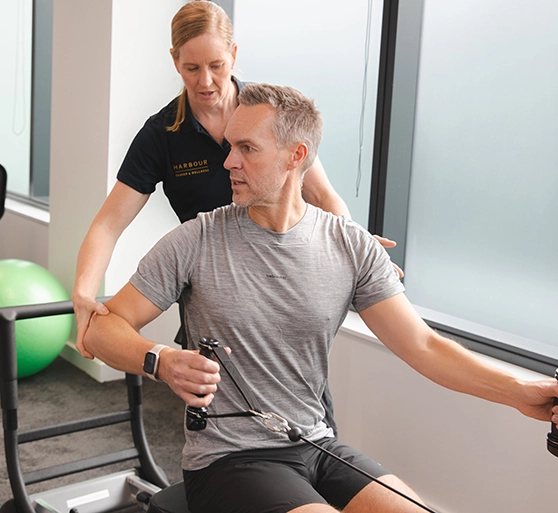
Our team of specialists takes a tailored approach to your treatment and rehabilitation, offering proven clinical benefits. At Harbour, we encourage the importance of exercise in cancer treatment. By engaging one of our oncology trained physiotherapists, you will receive a personalised exercise program designed to help you regain strength and fitness, reduce treatment side effects, shorten your postoperative recovery time, and improve long-term control of your cancer.
Beyond your treatment
Our wellness services are designed
to support you at every stage
of your cancer, helping
you live well during and beyond
your treatment.
SUPPORT SERVICES
There are several charities that support patients and their families coping with cancer and its treatment. Find out more on our support services page.
PARTICIPATING IN A CLINICAL TRIAL
We have a number of clinical trials available that may be suitable. Participation in a clinical trial makes a valuable contribution to cancer research and plays an important role in developing better treatments for patients, now and in the future.
Talk to your oncologist today

MANAGING SIDE EFFECTS
Cancer treatment can lead to various side effects, which can differ significantly among patients. The severity of these side effects also varies; some individuals may experience more intense symptoms than others.
Your doctor or nurse can inform you about which ones you may experience.